
FSL Standard 1.0 Released!
Accellera has announced the release of Functional Safety Language (FSL) Standard 1.0.
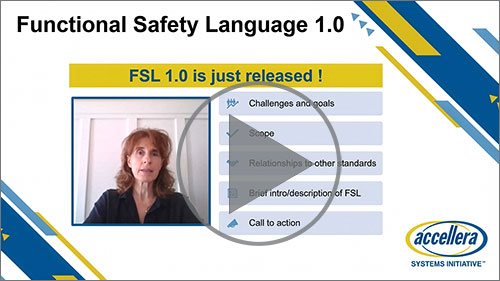
The new standard provides a common language for creating, exchanging, and reusing functional safety data across tools, teams, and the supply chain. With an initial focus on FMEDA, FSL 1.0 enables greater automation, interoperability, and traceability, helping streamline safety analysis and support the development of increasingly complex safety-critical systems.
Read the Functional Safety Language Standard 1.0 press release >
Download the Functional Safety Language Standard 1.0 >
PSS Training Session 16 Now Available
What Have We Learned? Bringing the Portable Stimulus Journey Full Circle.
In the final session of Accellera’s “Learning PSS” video series, Tom Fitzpatrick, PSS expert and charter member of Accellera’s Portable Stimulus Working Group, looks back at the key concepts explored throughout the series and shows how they work together to support the larger goal of the Portable Stimulus Standard: capturing verification intent once and reusing it across platforms, abstraction levels, and projects.
In this session, you’ll review:
- How PSS separates portable verification intent from target-specific realization, enabling reuse from IP to subsystem, SoC, software, and silicon
- How actions, activities, and control flow describe what needs to happen without hand-coding individual test sequences
- How constraints, randomization, scheduling, and inferencing allow tools to generate multiple legal scenarios from the same verification intent
- How flow objects, states, resources, components, pools, and binding help build scalable and reusable PSS models
- How packages, inheritance, and type extensions support reusable libraries and project-specific customization
- How address spaces, regions, and claims bring portable memory planning into generated scenarios
- How address handles, the Memory Access API, and executors connect portable models to target-specific execution
- How register models, groups, offsets, and handles enable portable register programming
- How PSS brings these capabilities together in a reusable, hierarchical abstract model that can generate verification scenarios across different target platforms
Watch Session 16 for a recap of the “Learning PSS” journey and see how the concepts covered throughout the series come together to enable greater portability, reuse, and verification productivity.
For details about PSS and other resources, visit the Portable Stimulus Working Group page.
View Session 16 >
View Full Course >
Featured Events
 DVCon Europe 2026
November 17-18
Munich, Germany
dvcon-europe.org
 SystemC Evolution Day 2026
November 19
Munich, Germany
systemc.org
Subscribe to our mailing list:
GET INVOLVED
Recent Happenings
- Learning PSS, complete 16-part tutorial series is now available
- August newsletter now available
- Article: Standards and AI will shape-shift EDA
- Article: DAC 2026: Accellera Luncheon Panel on Embracing AI for Advanced Design and Verification
- Article: Why the Semiconductor Industry Needs A Common Language For Functional Safety
- Article: Accellera Updates at DVCon 2026
- Article: What is the Accellera Systems Initiative?
Accellera News
- Accellera Approves Functional Safety Language Standard 1.0 for Release
October 21st, 2026 - Quote Sheet - Accellera Approves Functional Safety Language Standard 1.0 for Release
October 21st, 2026 - Quotes - Accellera Approves Clock and Reset Domain Crossing (CDC/RDC) Standard 1.0 for Release
March 2nd, 2026
Featured Videos
Learning PSS: 16-Part Video Tutorial Series
This educational course is designed to help engineers understand and apply the Portable Stimulus Standard (PSS). Presented by Tom Fitzpatrick, a PSS expert and charter member of the Accellera PSS Working Group, the series builds from core concepts to practical applications.
Latest Downloads
- Functional Safety Language 1.0
- Clock Domain Crossing (CDC) 1.0
- Federated Simulation Standard White Paper
- Portable Test and Stimulus Standard 3.0
- UVM 2020-3.1 Reference Implementation
- UVM Mixed-Signal 1.0
- IP-XACT XML Schema and Vendor Extensions
- SystemC 3.0.1, SystemC-AMS 2.3.4, CCI 1.0, & Synthesis 1.4.7
IEEE Get Program
As part of Accellera's ongoing partnership with the IEEE, Accellera standards are contributed to the IEEE Standards Association for formal standardization and ongoing change control.
The IEEE Get Program has resulted in more than 200,000 downloads to date. To view the standards available, visit the Available IEEE Standards page.
Login / Register
Access to some downloads and areas within the site is restricted. We encourage you to register and log in.
- Already Registered? Log in!
- Register for Access as a Member Employee
- Site help
- Reset username/password